You want a job in project finance. Maybe as an analyst, maybe in modeling, maybe on the lending side. Either way, someone is going to put you in front of an Excel screen during the interview and expect you to know what you are doing.
This post is for you.
I am going to walk you through a five-day bootcamp. Not a casual “read a few articles when you feel like it” kind of thing. This is a proper, intensive, wake-up-and-get-to-work schedule that will take you from wherever you are right now to someone who can sit in that interview with confidence.
Here is what I need from you: five days of your full, undivided attention. No half measures. You are going to read, watch, build, break things, fix them, and by the end of it, you will have built three financial models .
One honest word before we start: this schedule is aggressive. If it takes you seven or eight days instead of five, that is perfectly fine. The structure is what matters, not the speed. Follow the sequence, do the work, and do not skip steps.
Before You Start
A quick note on resources. Every single resource I mention here is free. You can download everything from the internet. There is only one exception: a book. You need to purchase it before you begin.
The book is Principles of Project Finance by Professor Yescombe. Get it in whatever format works for you, ebook or hard copy. This is your companion for the week. It is the most comprehensive and clearly written textbook on the subject, and you will come back to it throughout the five days. Buy it now so it is ready on Day One.
Let’s go.
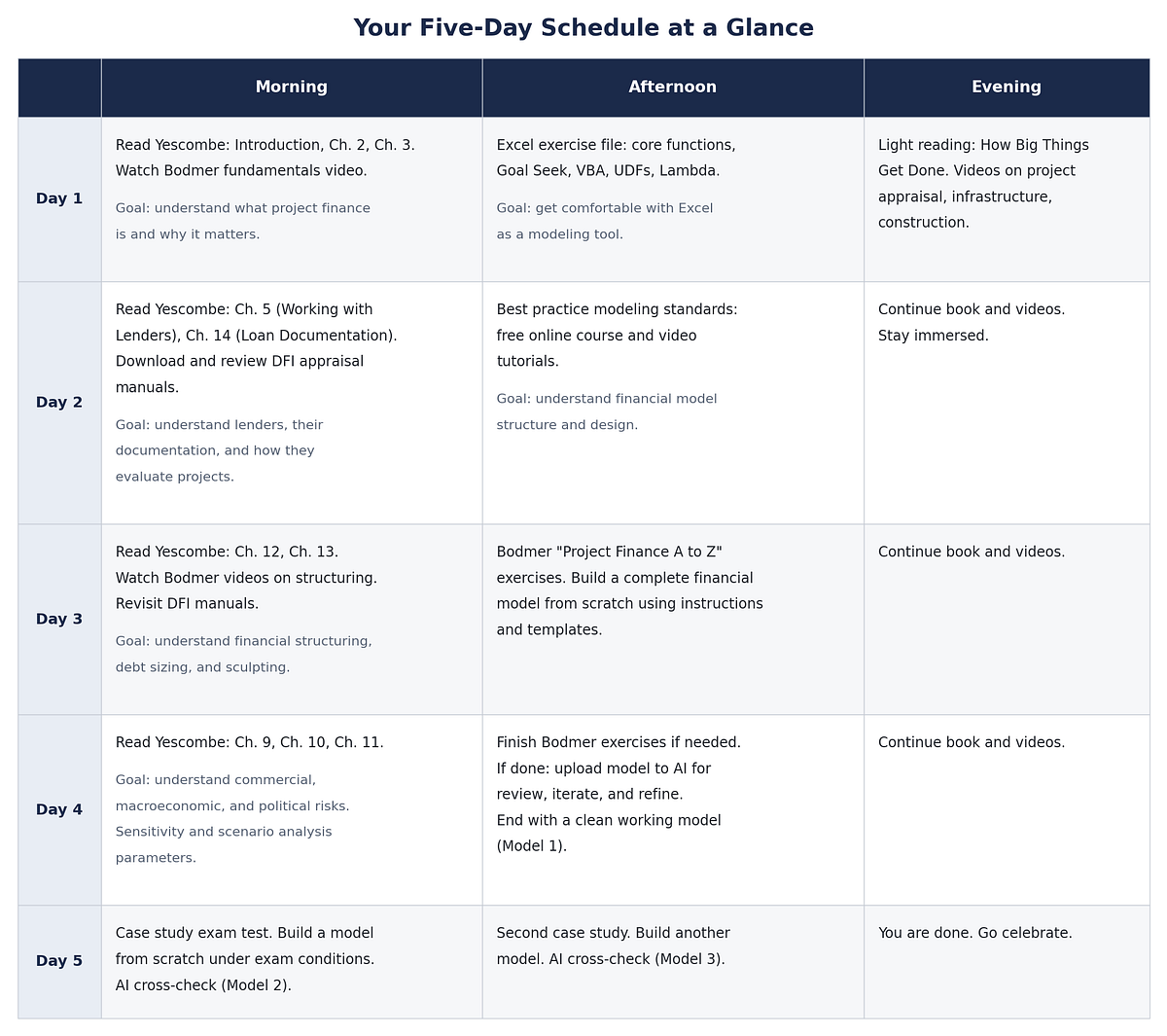
Your Five-Day Schedule at a Glance
Day One: What Is it?
Day One: Morning Session
Make your coffee. Grab the Yescombe book. Open it to the very beginning.
Read the Introduction, then Chapter 2: What Is Project Finance?, then Chapter 3: Project Development and Management. Take your time with these. Do not skim. The goal of this morning is simple: understand what project finance actually is, why it exists, and why it matters. If someone asks you in an interview “so, what is project finance and why do we use it?”, you should be able to give a clear, confident answer after this session.
Once you are done reading, go and watch Professor Edward Bodmer’s video on the fundamentals of project finance. If you still have time and energy, search for other introductory videos on the topic.
Essence of Project Finance and Project Finance Theory — Part 1
Essence of Project Finance and Project Finance Theory — Part 2
By lunchtime, you should be able to answer two questions:
- What is project finance?
- Why is it needed?
That is enough. Do not try to learn everything on Day One. Just nail these two.
Day One: Afternoon Session
Welcome back. Grab another coffee. This time, sit in front of your laptop with Excel open.
The purpose of this afternoon is to get comfortable with Excel as a modeling tool. Not as a spreadsheet for tracking expenses. As a modeling tool.
I have put together an exercise file that walks you through the basic Excel functions you will need when building a financial model. It covers core functions, Goal Seek, writing a simple VBA macro, creating a user-defined function, and building a basic Lambda.
Day One: Evening Wind-Down
When you get into bed, do not reach for the Yescombe book. It is too technical for nighttime reading.
Instead, I recommend How Big Things Get Done (optional purchase, but a genuinely enjoyable read). It tells the real stories behind major infrastructure projects: what went wrong, what went right, and why projects fail during development and construction. It will put you in the right headspace without making your brain hurt before sleep.
You can also watch videos on your phone or tablet about project appraisal, construction, infrastructure, anything that keeps you in that world without requiring deep concentration.
Day Two: Meet the Lenders
Day Two: Morning Session
Coffee. Yescombe. This time, read Chapter 5: Working with Lenders and Chapter 14: Project-Finance Loan Documentation.
The goal this morning is to understand who the key players are on the other side of the table. Chapter 5 introduces you to lenders: who they are, what instruments they offer, how they look at a deal, and what their priorities are. Chapter 14 takes you into the documentation that governs these loans, the terms, conditions, and covenants that shape every deal.
After reading, go and download the project appraisal manuals published by development finance institutions. The African Development Bank, the World Bank, and the Asian Development Bank all publish these. They are free, they are publicly available, and they are gold. These manuals show you exactly how lenders evaluate a project and what analysis they require. Read through them after the Yescombe chapters and you will start to see the connections.
Day Two: Afternoon Session
Back to the screen. This afternoon is about best practice financial modeling standards.
Before you build anything serious, you need to understand how a model should be designed and structured. Think of it as learning architecture before you start laying bricks. This session is about the skeleton of a financial model: how sheets are organized, how inputs flow into calculations, how outputs are presented.
I have a free online course that covers this and can be completed in one afternoon. There are also video tutorials included. On top of that, go and read the published manuals on best practice financial modeling standards.
Day Two: Evening Wind-Down
Continue with your book or watch other content that keeps you immersed in the project finance world.
Day Three: Now We Build
Day Three: Morning Session
Coffee. Yescombe. Read Chapter 12: Financial Structuring and Chapter 13: The Financial Model.
This is where things get real. You are now moving beyond just debt and lenders into the full range of financing instruments: equity, mezzanine, subordinated debt, the works. You will learn how these instruments are structured, how debt is sized and sculpted, and how the financial model is the tool that makes all of this possible.
Watch the related videos on Professor Edward Bodmer’s website if time permits.
Here is a useful tip: after reading these two chapters, go back to those development finance institution manuals you downloaded on Day Two. Read them again. You will understand the terminology and the requirements much better now that you have the theory from Chapters 12 and 13.
Day Three: Afternoon Session
This is the big one. Clear your desk.
Go to Professor Edward Bodmer’s website and find his “Project Finance from A to Z” materials. These are structured as a series of exercises that walk you through building a complete financial model from scratch, step by step, with written instructions and video guidance.
Use his templates or start from a blank sheet. Spend the entire afternoon working through these exercises. Take your time, follow the instructions, and build.
By the end of this afternoon, you should have a financial model that you built yourself. It does not need to be perfect. You need to understand what every part of it does.
Day Three: Evening Wind-Down
Same as before. Light reading, videos, stay in the zone.
Day Four: Risk, Refinement, and Your First AI Review
Day Four: Morning Session
Coffee. Yescombe. Read Chapter 9: Commercial Risks, Chapter 10: Macroeconomic Risks, and Chapter 11: Regulatory and Political Risk.
Three chapters, one morning. The goal here is to understand the parameters in a financial model that matter for sensitivity and scenario analysis. What can go wrong? Who bears each risk? How is each risk mitigated? These are the questions that interviewers love, and that modelers need to think about every time they build an assumption.
Day Four: Afternoon Session
This afternoon depends on where you are.
If you did not finish the Bodmer exercises from Day Three: continue and complete them. Take the time you need to get to a working model.
If you did finish: here is where it gets interesting. Take the financial model you built and upload it to an AI tool. Ask it to review the model, flag mistakes, and suggest improvements. Read through every item on the feedback list. Fix what needs fixing. Then do a second iteration: upload the improved model, ask for another round of feedback, and refine again.
By the end of this afternoon, you should have a clean, reviewed, working financial model. That is Model Number One.
Day Four: Evening Wind-Down
Continue your reading. Stay in the world.
Day Five: Exam Day
Day Five: Morning Session
No theory today. No reading. Just you, Excel, and a case study.
Professor Edward Bodmer has gathered a large collection of case study exam tests over the years, the kind that employers actually use in project finance interviews. Some come with answer keys. Some do not.
Pick one. Set a timer if you want to simulate real conditions. Build the model from scratch. When you are done, upload it to an AI tool, cross-check your work, and review the feedback.
Day Five: Afternoon Session
Pick another case study. Do it all again. Different project, different assumptions, same discipline.
Build it. Check it. Fix it.
What You Walk Away With
In five days, you have:
- Read the core chapters of the definitive textbook on project finance
- Understood what project finance is, who the stakeholders are, how deals are structured, and what risks matter
- Learned best practice financial modeling standards
- Built three financial models with your own hands
- Used AI to review and improve your work
- Familiarized yourself with real interview-style case studies
You are not an expert. Five days does not make anyone an expert. There are many other things you will have to learn, and most of them you will only learn by doing. So do not be intimidated if after these five days you still feel uncomfortable with certain concepts or modeling complexities. That is completely normal.
What you have now is a solid starting point. A real one. And if you found that you actually enjoyed these five days, that the reading pulled you in, that building those models gave you a buzz, then you already have the most important thing: genuine interest.
Take one more day. Work on your confidence and your communication skills. Practice explaining what you learned out loud. Then start going for interviews.
Jump in the ocean of project finance. You might even enjoy the ride.
Recommended Resources
Books
Principles of Project Finance (Second Edition)
Author: E.R. Yescombe
Publisher: Academic Press (Elsevier), 2013
Amazon: https://www.amazon.com/Principles-Project-Finance-R-Yescombe/dp/0123910587
How Big Things Get Done: The Surprising Factors That Determine the Fate of Every Project, from Home Renovations to Space Exploration and Everything In Between
Authors: Bent Flyvbjerg and Dan Gardner
Publisher: Currency (Penguin Random House), 2023
Amazon: https://www.amazon.com/How-Big-Things-Get-Done/dp/0593239512
Corporate and Project Finance Modeling: Theory and Practice (Wiley Finance)
Author: Edward Bodmer
Publisher: John Wiley & Sons, 2014
Amazon: https://www.amazon.com/Corporate-Project-Finance-Modeling-Practice/dp/1118854365
Financial Model Detective: Hints and Tricks for Review of Financial Models
Author: Hedieh Kianyfard
Publisher: Independently published, 2019
Amazon: https://www.amazon.com/Financial-Model-Detective-tricks-financial/dp/1074174607
Modern Project Finance: A Casebook
Author: Benjamin C. Esty
Publisher: John Wiley & Sons, 2003
Amazon: https://www.amazon.com/Modern-Project-Finance-Benjamin-Esty/dp/0471434256
Youtube Channels
Hedieh Kianyfard (Financial Model Detective)
Practical project finance modeling, model review techniques, and hands-on tips from a seasoned financial modeler with extensive experience on infrastructure projects in Africa.
YouTube: https://www.youtube.com/@FinancialModelDetective
Website: https://www.finexmod.com
Professor Edward Bodmer
Comprehensive project finance theory and modeling, including A-to-Z model-building exercises, debt structuring, circular references, sculpting, and case studies. Hundreds of free videos and downloadable Excel files.
YouTube: https://www.youtube.com/c/EdwardBodmer
Website: https://edbodmer.com
Manuals and Standards
South Africa National Treasury — Project Finance Introductory Manual
A generic, sector-agnostic introductory manual covering SPV structures, investor profiles, risk categories, financial ratios, and funding alternatives.
PDF: https://www.ppiaf.org/sites/ppiaf.org/files/documents/toolkits/Cross-Border-Infrastructure-Toolkit/Cross-Border%20Compilation%20ver%2029%20Jan%2007/Resources/Treasury%20SAfrica%20-%20Finance%20Introductory%20Manual.pdf
African Development Bank — Guidelines for Financial Management and Financial Analysis of Projects
Covers the full project cycle from identification through appraisal, supervision, and completion. Includes financial evaluation methodology, sensitivity analysis, and reporting requirements for Bank-financed projects.
PDF: https://www.afdb.org/fileadmin/uploads/afdb/Documents/Procurement/Project-related-Procurement/GFA01_Guidelines%20for%20FG%20&%20FA%20of%20Proj.pdf
Asian Development Bank — Guidelines for the Economic Analysis of Projects
General methodology for project analysis covering financial viability, sustainability, distributional impacts, treatment of uncertainty, and consistency with macroeconomic policies.
PDF: https://www.adb.org/sites/default/files/institutional-document/149712/guidelines-economic-analysis-projects.pdf
World Bank — Project Finance at the World Bank: An Overview
Covers World Bank financial instruments for project finance, the legal and structural issues, the role of IFC and MIGA, and how the Bank supports limited-recourse financing in developing countries.
PDF: https://documents1.worldbank.org/curated/en/224601468741297994/pdf/multi-page.pdf
World Bank — PPP Reference Guide (Version 3)
The most comprehensive generic reference on PPP project development, co-developed by the World Bank, ADB, IADB, EBRD, and others. Covers the full lifecycle from policy frameworks through procurement and contract management.
PDF: https://ppp.worldbank.org/sites/default/files/2024-08/PPP%20Reference%20Guide%20Version%203.pdf
FAST Standard — Financial Modelling Standard
The most widely adopted independent financial modeling standard. Covers model structure, design, formulas, and layout rules. FAST stands for Flexible, Appropriate, Structured, and Transparent.
Website: https://fast-standard.org/the-fast-standard/
Your Five-Day Schedule at a Glance
All resources mentioned are free to download from the internet, with the exception of Professor Yescombe’s book, which must be purchased before starting. Links to all resources are provided above.