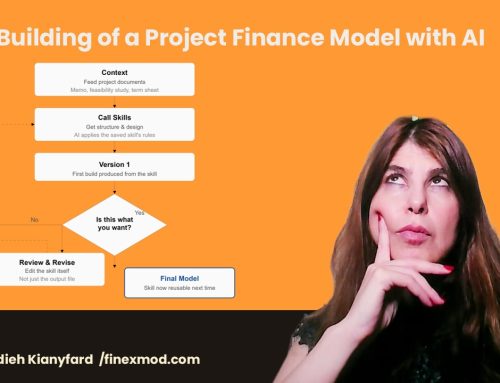
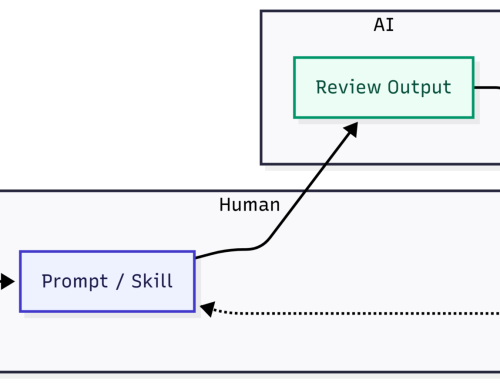
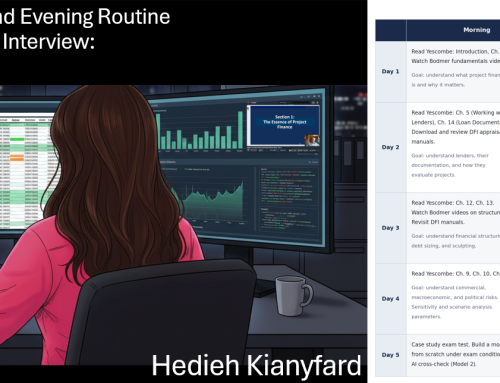
A couple of weeks ago I led a training for a group of young professionals. I was showing them the use cases of AI in financial modeling and how to review and build project finance models using it. After the session, one of them asked me: After the session, one of them asked me: “Is AI going to replace financial modelers”
There was no curiosity in his voice. It was fear and that is why the question stayed with me. I did not overthink my answer. I told him: “It will improve the quality of your work.”
But now I am asking myself whether AI will replace financial modelers. This is not a binary question with a true-or-false answer. At least not today and the response requires a scenario analysis.
Three Scenarios come to mind:
- Scenario 1: AI Takeover
- Scenario 2: Status Quo
- Scenario 3: Age of Abundance
Scenario 1: The AI Takesover (Probability: 10%)
A handful of players could develop agents specialized in financial modeling. You buy an additional subscription, prompt the system, and launch the process; the agent then produces the report and runs the scenarios. No spreadsheet work is involved, only reports and dashboards remain. Human expertise is replaced with AI skills and loops.
The key feature of this world is not the technology but what the legal environment permits. It no longer requires human involvement in the process. It stops requiring a human to verify the end results. What gets checked is the tool itself, which is validated and updated from time to time. Once regulators, auditors, and lenders accept the AI tool as reliable, human review disappears, and Excel becomes obsolete, used only for teaching basic concepts.
I assign it a ten percent probability of occurrence. No investor wants to take on extra risk or hand confidential data to a third party outside the project company, so data privacy alone is a serious issue. The cost of AI is another key factor.
Scenario 2: Status Quo (Probability: 30%)
Over time, the hype subsides. AI becomes another tool alongside Excel, useful but not transformative. Data privacy, security, and the running cost of full automation keep it in a supporting role. And there is a another reason the human stays an the main element in the process. A project finance model is not only a spreadsheet, it is a legal instrument that someone signs and can be sued over. Until liability is clearly defined when an AI-built model causes deal failure, auditors and lenders’ counsel will require a named human to sign off on the model, whether the sponsor, adviser. procedures are put in place to detect AI-built models and keep review under human control. The main impact is reduced audit and model build costs, but those savings are rarely passed on to the project.
Scenario 3: The age of Abundance (Probability: 60%)
To understand this scenario, it is necessary to acknowledge something uncomfortable:
Our models are not perfect.
This is true both in structure and in accuracy.
Our ability to predict the far future is limited, which is why the base case we present rarely materializes. And we live with a permanent trade-off between structure and flexibility.
Are there ways to make our models even more Structured, efficient and yet flexible and accurate? Yes, there are ways but What blocks them is not technology, but the failure to acknowledge deficiencies and apply effective solutions. This is where AI can create value. Not by replacing the modeler, but by making financial modeling accessible to everyone rather than a select group of firms. With more people building financial models, they become better and cheaper, due diligence becomes more efficient, and more high-quality deals make it into the pipeline.
The key distinction from the takeover scenario is that the industry retains its autonomy. Excel does not disappear, it becomes the presentation layer, while the build moves into code. That does not reduce transparency; the solutions and techniques still yield flexible, accurate, structured, and transparent financial models. This is exactly where Professor Bodmer’s parallel-model technique leads: it replicates circular equations within a functional framework. AI can help make these somewhat complex techniques more approachable for financial modelers.
Professor Bodmer and I are planning a series of seminars and masterclasses on the parallel-model technique. If you would like to join, feel free to get in touch with either Professor Bodmer or me.
The three scenarios at a glance
| Dimension | Scenario 1: AI takesover | Scenario 2: Status quo | Scenario 3: Age of abundance |
| Probability | 10% | 30% | 60% |
| Core idea |
|
|
|
| What AI does to the modeler |
|
|
|
| What AI does to MS Excel |
|
|
|
| Role of the human |
|
|
|
| Impact on the industry |
|
|
|
| Conditions/Issues |
|
|
|
Incremental Distributive Analysis (With AI minus Without AI)
| Stakeholder | Scenario 1: AI takes over | Scenario 2: Status quo | Scenario 3: Age of abundance |
| Financial modelers and modelling firms | NPV below zero. The clear losers. | Roughly NPV zero. Largely unchanged. | Skilled modelers: NPV above zero. Unskilled labor: NPV below zero. |
| Project sponsors | NPV above zero, but the gain depends on how expensive the tokens turn out to be. | NPV slightly above zero. | NPV above zero. Better analysis, better deals. |
| Lenders | NPV above zero. Cost cutting. | NPV slightly above zero. | NPV above zero. Cost cutting. |
Wrap-Up
Returning to the young professional and his fear. My probabilities suggest that the most likely future is one where his work improves, not disappears, as long as he is a modeler who applies judgment rather than one who merely copies and pastes. The fear is not about AI. It is about which kind of modeler you choose to be.
Do you see another scenario?
Hedieh
June 2026